Public-facts intake
Share website, NAICS/PSC targets, agencies, certifications, public past performance, and capacity limits.
We monitor SAM.gov, score bid/no-bid fit, prepare capture briefs, and build compliance matrix starters so your team pursues fewer bad-fit federal opportunities.
Not affiliated with the U.S. Government. No proposal submission, government-buyer contact, legal advice, pricing advice, certification advice, or award guarantee.
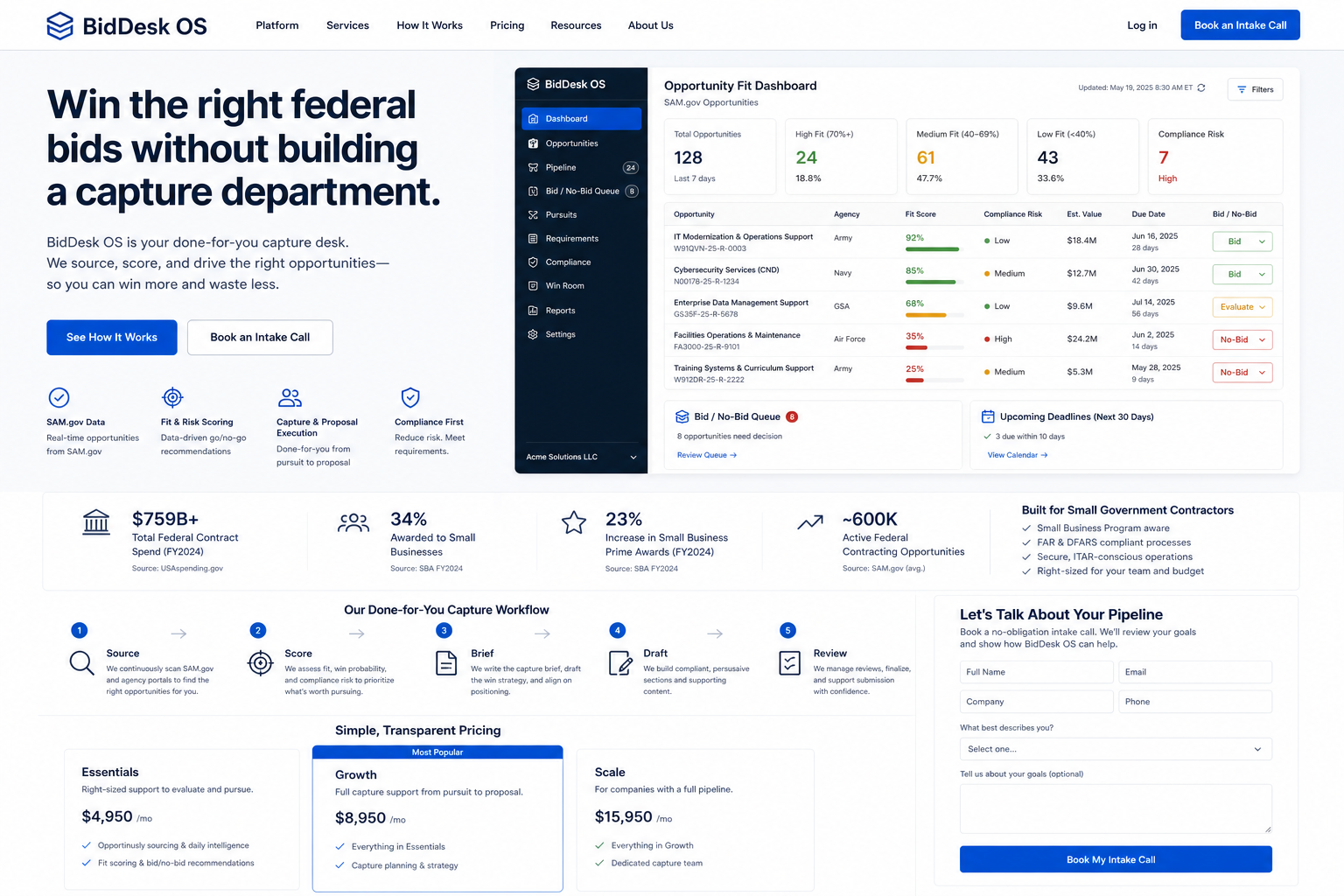
Opportunity Fit Dashboard
| Opportunity | Agency | Fit | Risk | Due | Action |
|---|---|---|---|---|---|
| IT modernization support NAICS 541512 - set-aside match | Army | 92% | Low | 12 days | |
| Cybersecurity advisory services Past performance adjacent | Navy | 85% | Medium | 28 days | |
| Data management support Scope split recommended | GSA | 68% | Low | 34 days | |
| Facilities maintenance IDIQ Bonding and geographic mismatch | Air Force | 35% | High | 8 days |
Federal contract obligations in FY2024, according to GAO.
Prime awards to small businesses in FY2024, according to SBA.
Public Opportunities API provides current opportunity details.
The product is the operating cadence: briefs, decisions, and pursuit workpapers.
The first purchase is not a long retainer. It is a focused scan that shows whether your public GovCon profile, live opportunity flow, and pursuit capacity justify recurring capture support.
Share website, NAICS/PSC targets, agencies, certifications, public past performance, and capacity limits.
We review public SAM.gov and related source data for realistic matches, deadlines, set-asides, and risk flags.
You receive scored fit notes, likely value context, no-bid rationale, and the few pursuits worth reviewing.
The scan ends with next actions: monitor, bid, partner, ask questions, wait, or avoid the opportunity.
If the scan proves enough qualified volume, credit the scan toward month one when you convert within 14 days.
Small contractors do not lose only because they miss opportunities. They lose time chasing bad fits, reading dense solicitations too late, and starting proposals without a clean compliance map. This service turns public data into a weekly capture rhythm.
Search, alerts, award data, saved pipelines, and analysis for teams that already have capture capacity.
Agent-prepared fit briefs, bid/no-bid scorecards, compliance starters, pursuit notes, and proposal-support workpaper drafts for client review.
BidDesk OS is not another contract-alert inbox. It is a managed workflow for contractors that need daily opportunity monitoring, clear bid/no-bid decisions, and proposal readiness.
Pipeline discipline, pursuit notes, review cadence, and weekly client-ready decisions.
SAM.gov monitoringPublic notices filtered by NAICS, PSC, set-aside, agency, deadline, and capability fit.
Bid/no-bid analysisFit scores, risk flags, no-bid reasons, and next-action recommendations for each pursuit.
Compliance matrixInstructions, evaluation factors, attachments, question lists, outlines, and workback plans.
Each agent owns one repeatable business function. The human operator approves the calls that matter.
Pulls SAM.gov searches, agency forecasts, prior awards, and saved NAICS/PSC monitors.
Ranks opportunities against capabilities, past performance, geography, contract size, and set-aside fit.
Creates opportunity briefs with buyer history, incumbents, deadlines, risks, and recommended next steps.
Extracts instructions, factors, attachments, representations, and required submission artifacts.
Prepares outlines, response shells, capability mappings, questions, and review-ready draft sections.
Flags CUI, export-control, pricing, labor, bonding, legal, and certification issues for human approval.
The workflow is built to reduce false starts and protect the client from sloppy AI output.
Daily monitors pull relevant notices, amendments, set-asides, due dates, and agency signals.
Agents score fit using the client's capabilities, constraints, past performance, and win themes.
Every qualified lead gets a one-page capture brief with risk, timeline, partners, and next action.
For approved pursuits, the desk drafts a compliance matrix, outline, question list, and workback plan.
Human review gates cover bid/no-bid calls, proposal claims, pricing inputs, submissions, and outreach.
The website is only the front door. The real moat is the repeatable capture workflow, account targeting, approval queues, templates, and scorecards packaged in this workspace.
Priced above research software, below a full-time capture hire, and scoped so every month has a clear reason to renew.
$1,500 one-time
A bounded first engagement for contractors that want proof before a monthly desk.
$1,500/mo
For contractors that need a disciplined weekly pipeline before they hire capture staff.
$4,500/mo
The core offer: opportunity intelligence plus pursuit preparation for active bidders.
$8,500/mo
For contractors with a larger pipeline and recurring proposal pressure.
The first week is built to feel concrete: intake, source review, fit scoring, workpapers, delivery, and a clear go/no-go recommendation before a retainer is discussed.
Confirm the scan scope, public facts, safe data boundaries, target agencies, NAICS/PSC codes, and capacity limits.
Turn your capabilities into a search profile and review what should be monitored, ignored, or partner-screened.
Review current opportunities, likely value, competition risk, compliance pressure, deadlines, and no-bid blockers.
Receive the Bid-Fit brief, source links, decision notes, workpaper starters, and a 30-day pursuit plan in the portal.
Retainers are not just more alerts. Each month should show screened opportunities, decisions made, workpapers delivered, renewal value, and the next actions waiting on the client.
Ranked opportunities with fit, due dates, source links, set-aside notes, and risk flags.
Bid, no-bid, partner-screen, watch, and stop decisions with evidence and approval history.
Compliance matrix starters, proposal outlines, question lists, partner notes, and workback plans.
Scoped portal access with delivered briefs, open decisions, acknowledgements, corrections, and exports.
Estimated pipeline value, avoided bad-bid hours, delivered artifacts, and clear reasons to continue or pause.
Capture Desk clients get weekly review rhythm so the queue does not become another ignored inbox.
BidDesk OS uses public procurement data and client-approved facts. Every deliverable should include source links, review status, and approval history so the client knows what is evidence and what is recommendation.
We sell process quality, pipeline discipline, and proposal readiness, not guaranteed awards.
We prepare review-ready briefs and workpaper starters; the client remains responsible for final submission.
Eligibility, legal conclusions, representations, pricing, and contract commitments stay with qualified advisors and the client.
CUI, FCI, export-controlled material, proprietary pricing, and final proposal content require written handling approval.
Bid/no-bid calls, outreach, client claims, public proof, paid tools, and spending require recorded approval.
Short answers, clear boundaries, and no award promises.
A capture desk is the operating system before proposal writing: opportunity monitoring, qualification, bid/no-bid decisions, pursuit notes, and proposal preparation.
SAM.gov alerts tell you something posted. BidDesk OS reviews whether it fits your capabilities, timeline, past performance, set-aside status, and proposal capacity.
No. Those tools are useful data platforms. BidDesk OS can sit downstream and turn opportunity data into recurring decisions and workpapers.
No. BidDesk OS prepares review-ready briefs and workpaper starters. The client remains responsible for final review, pricing, representations, and submission.
No. We improve decision quality and proposal readiness. Awards depend on agency needs, competition, price, compliance, past performance, and evaluation factors.
Use public company facts for intake. Do not submit CUI, FCI, export-controlled material, classified material, proprietary pricing, or final proposal content unless a written handling process is approved.
Share only public company facts. If the intake queue is unavailable, the page will say so before you rely on it. Payment, card details, sensitive proposal files, and final proposal content are never collected here.
Questions before intake? Email support@biddeskos.com.